Join the 2026-2027 research fellows cohort:  Learn More

<

1

  • Campaigns
  • Donate
  • About Us
  • Join Us
  • !
    Programs
  • !
    Research

2026

NIP Award

Neuro-Inclusive Politician Award

Celebrating politicians who give neurodivergent people hope

The Neuro-Inclusive Politician Award, commonly called the NIP Award, celebrates politicians who give neurodivergent people hope for a neuro-inclusive future.

The award recognizes political courage, dignity, justice and concrete action. It is given to politicians who, each in their own field of focus, have shown a neurodiversity- or neurodivergent-friendly approach in the political arena. These are the politicians who help create a society in which there is equitable space for everyone, regardless of the type of brain you were born with.

For neurodivergent people, politics is not abstract. Decisions made in parliaments, councils and ministries shape whether a child receives safe and respectful support, whether an adult is treated fairly at work, whether harmful practices are challenged, whether public systems recognize difference without turning it into stigma, and whether people are allowed to participate without first having to become someone else.

The NIP Award exists to make hopeful political leadership visible. It honors politicians who listen to neurodivergent people, take lived experience seriously and turn that listening into concrete action. It is not an award for perfect politicians or perfect parties. It is an award for meaningful steps, principled courage and the willingness to use political power in ways that create more dignity, more justice and more room for minds of all kinds.
The NIP Award started in the Netherlands and is now growing internationally. In 2025, the award was presented both in the Netherlands and in India, and preparations have started for more countries to have their own NIP Award. This marks a new phase for the award: from a Dutch recognition of political hope to a growing international invitation to celebrate the people in politics who help build neuro-inclusive societies.

On this page, find:

  • What the NIP Award is
  • Current winners
  • Why the award matters
  • Winners of the NIP Award
  • The 2025 Netherlands award
  • The 2025 India award
  • Previous winners
  • How the award works
  • The Neurodiversity Scorecard
  • International expansion
  • Suggested winner stories
  • Image inventory

What is the NIP Award?

The Neuro-Inclusive Politician Award is a recognition for nominated politicians who have shown a neurodiversity- or neurodivergent-friendly approach in the political arena.

These are politicians who give hope to neurodivergent people for a neuro-inclusive future.

Every two years, after a research period, nominees are selected. The winner is chosen by an independent jury of neurodivergent people during an evaluation and analysis period.

The award is not connected to one political ideology. Politicians from different parties and traditions can contribute to a neuro-inclusive society. The NIP Award supports and rewards direct effort, thoughtful action and genuine commitment - not a particular party line.

The award exists to honor politicians who actively demonstrate that society can make space for every kind of mind.

Current winners

Netherlands 2025–2026

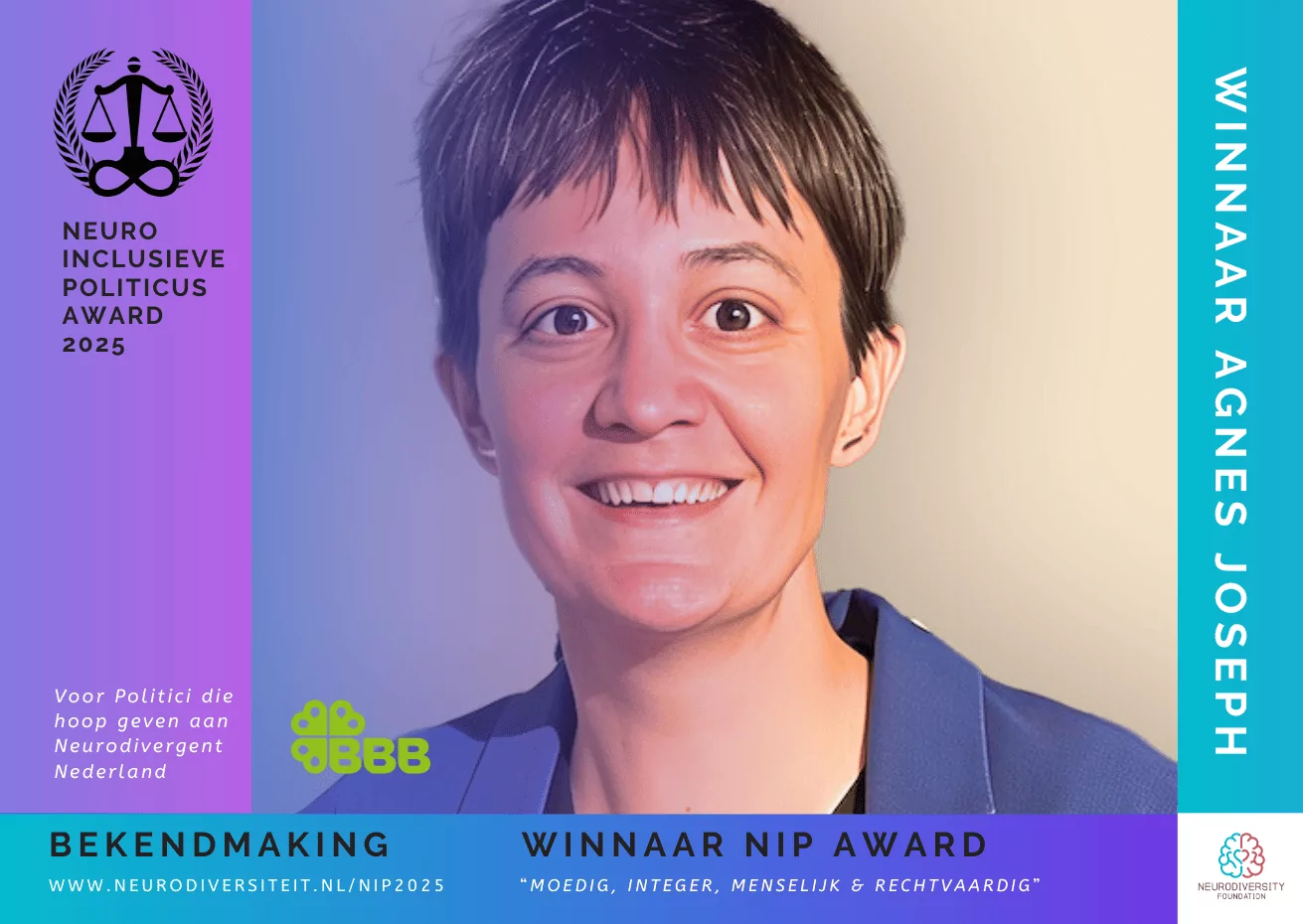
Agnes Joseph - Winner NIP Award

Agnes Joseph, Member of Parliament for the BoerBurgerBeweging, was named winner of the Neuro-Inclusive Politician Award 2025–2026 in the Netherlands.

The jury recognized her as a courageous, sincere and listening politician who does not speak for the people affected by policy, but with them.

She stood out through concrete legislative results and by structurally involving the target group in her work. Her role in ending discriminatory driving-license medical checks for people with autism, ADHD and ADD was seen as a breakthrough in the fight against neurological discrimination.

In 2025, Joseph also made history with Motion 370, which asked the Dutch government to effectively exclude the offering and/or reimbursement of ABA treatments more intensive than one hour per week, making room for safer and non-harmful care alternatives.

The motion passed with a 92 percent majority and was celebrated by neurodivergent communities in multiple countries as a hopeful signal of progress.
India 2025

Maneka Gandhi - Winner NIP Award 

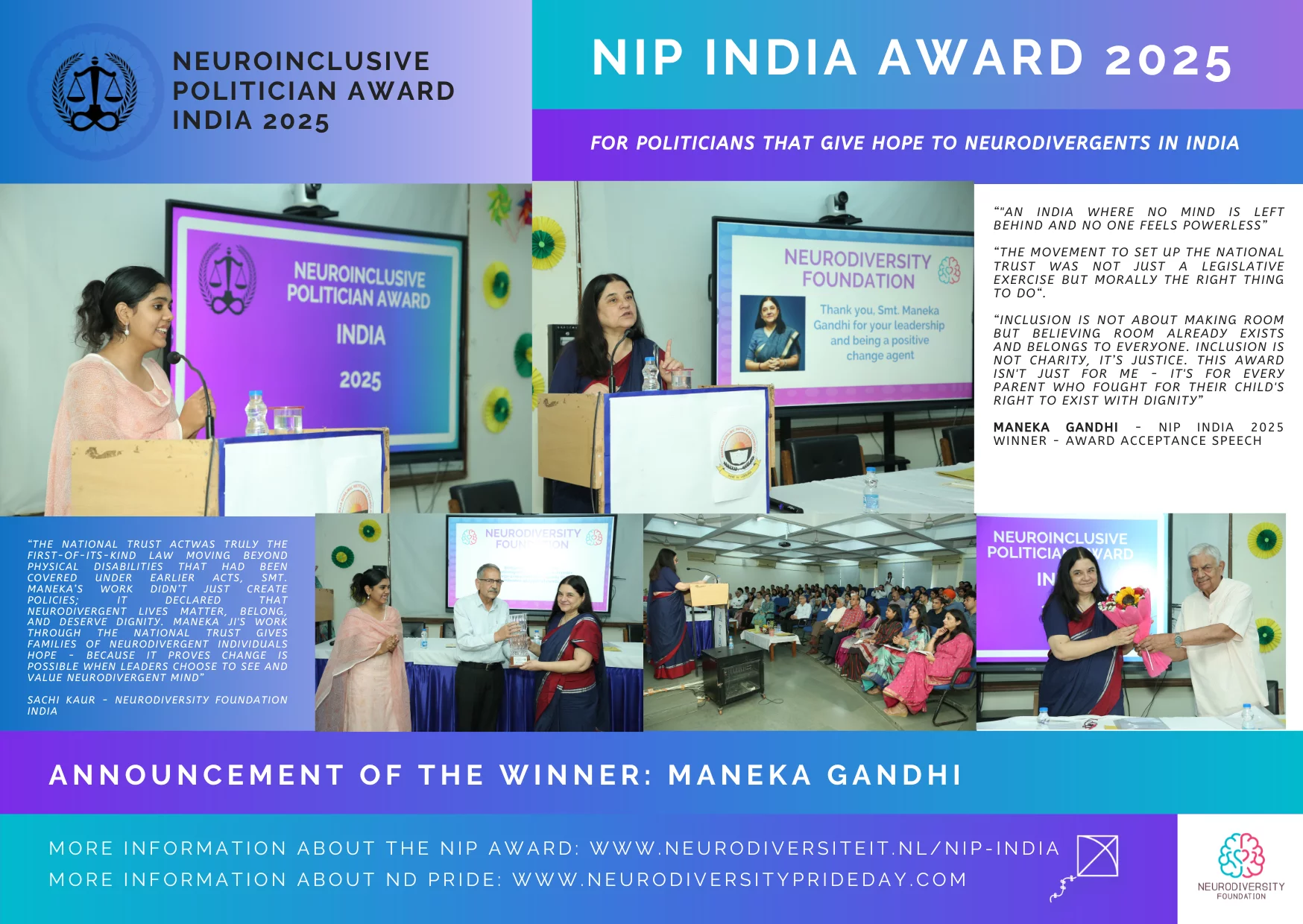
On April 16, 2025, the Neurodiversity Foundation presented its first Neuro-Inclusive Politician Award in India to Smt. Maneka Gandhi during a ceremony at Maharaja Surajmal Institute of Technology in New Delhi.

The event recognized her groundbreaking work in establishing The National Trust for Welfare of Persons with Autism, Cerebral Palsy, Mental Retardation, and Multiple Disabilities in 1999 - a pivotal step in securing rights for neurodivergent individuals in India.

Smt. Gandhi received a standing ovation and spoke about an India “where no mind is left behind and no one feels powerless.” Her message was clear: inclusion is not charity, but justice.

The event was coordinated by Sachi Kaur, India Project Lead for the Neurodiversity Foundation, with the full backing of the Foundation.

Why the NIP Award matters

Neurodivergent people often feel that their interests are invisible in politics. The NIP Award exists because visibility, dignity and political courage matter.

For millions of neurodivergent voters and their families, it matters when politicians take their voices seriously. It matters when discriminatory systems are dismantled. It matters when harmful practices are challenged. It matters when children are protected from confinement or coercive treatments. It matters when politicians listen to the people affected by policy, instead of only listening to institutions.

The NIP Award is not a popularity contest. It is a recognition of character, reliability and decisiveness, evaluated by people from the target group.

It is a signal to politicians and society that neurodivergent people are not asking for favors. They are asking for justice.

Dignity and equality are not gifts. They are rights.

The 2025 Netherlands award

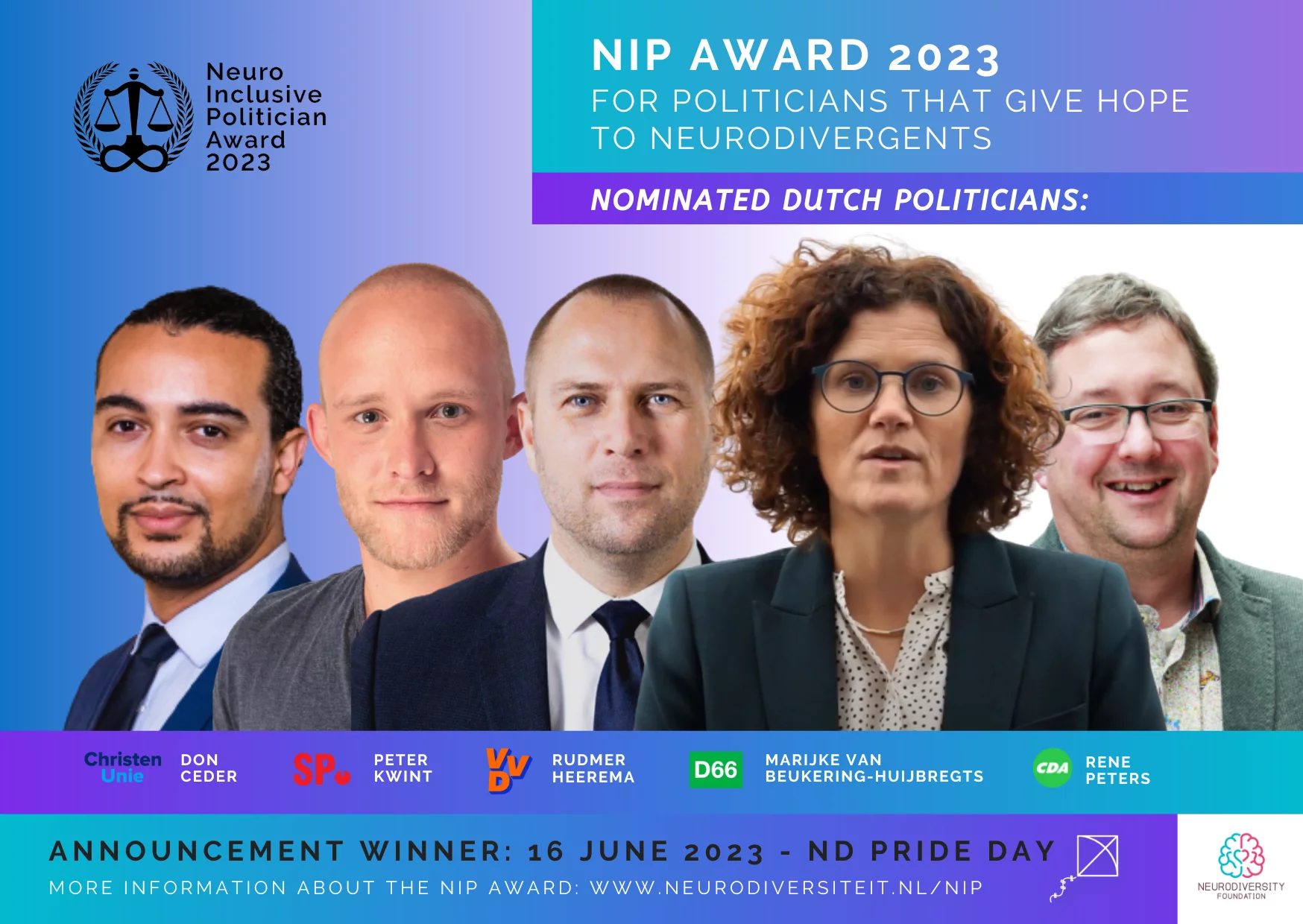
The 2025 Dutch edition of the NIP Award recognized five politicians who contributed to a more neuro-inclusive Netherlands through their work on neurological discrimination, youth care, harmful treatments, closed institutions, education, recognition and political participation.

The nominees were Agnes Joseph of BBB, Faith Bruyning of NSC, Rosemarijn Dral of VVD, Patrick Crijns of PVV and Sarah Dobbe of SP.

The jury selected Agnes Joseph as the winner because of her combination of listening, integrity, legislative results and direct involvement of neurodivergent people and advocacy organizations.

Her full winner story, including Motion 370, the end of discriminatory driving-license medical checks, the jury quotes and the full nominee context, should be published as a separate article.

Suggested link: Read the full article about Agnes Joseph and the NIP Award Netherlands 2025–2026.

The 2025 India award

The 2025 India edition marked the first time the NIP Award was presented outside the Netherlands.

By honoring Smt. Maneka Gandhi, the Neurodiversity Foundation recognized her pioneering role in establishing the National Trust and the long-term importance of political leadership in securing dignity and rights for neurodivergent communities.

The award ceremony in New Delhi also reflected the growth of Neurodiversity Pride and neuro-inclusion work in India, following India’s first ND Pride Day activities across three cities in 2024.

The full India story, including the ceremony, expert talks, attendees, quotes and media references, should be published as a separate article.

Suggested link: Read the full article about Maneka Gandhi and the first NIP Award India.

Previous winners

2023–2024

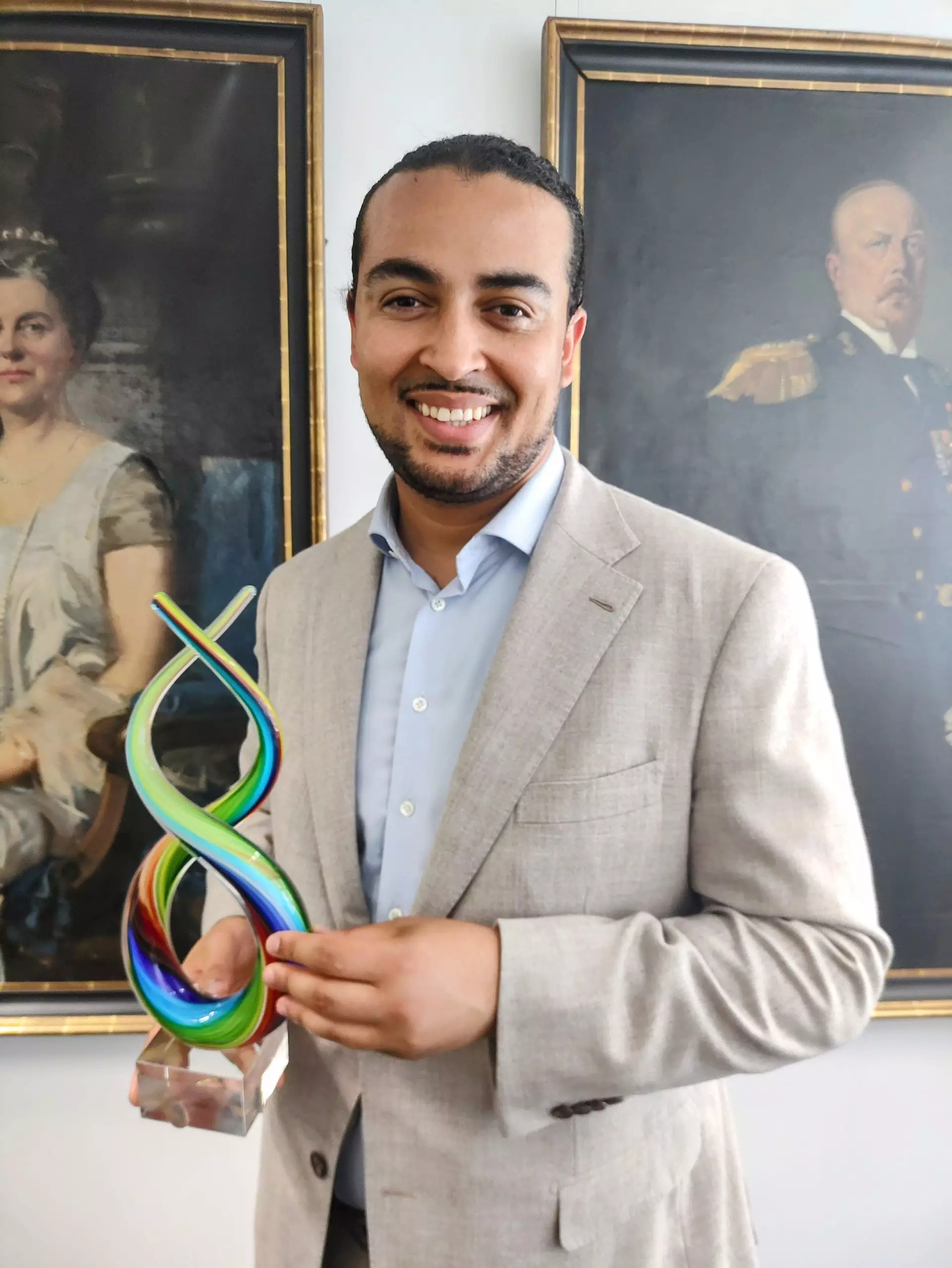
Don Ceder - Winner NIP Award 

Don Ceder of the ChristenUnie won the third edition of the Neuro-Inclusive Politician Award.

The jury named the fresh wind that his ideas brought into his political party, his solidarity-driven work, his view on inclusion and diversity, his supported motions and his convincing message as important reasons for the decision.

Especially his vision of the right to be unique - at school and beyond - inspired the jury.

One of the strongest messages connected to his award was: if it does not fit, the problem is the box, not the person.

Ceder emphasized that society should not only ask people to adapt, but should also create room for new ways of seeing how people can participate, belong and contribute - even when they are different or unusual.
2021–2022

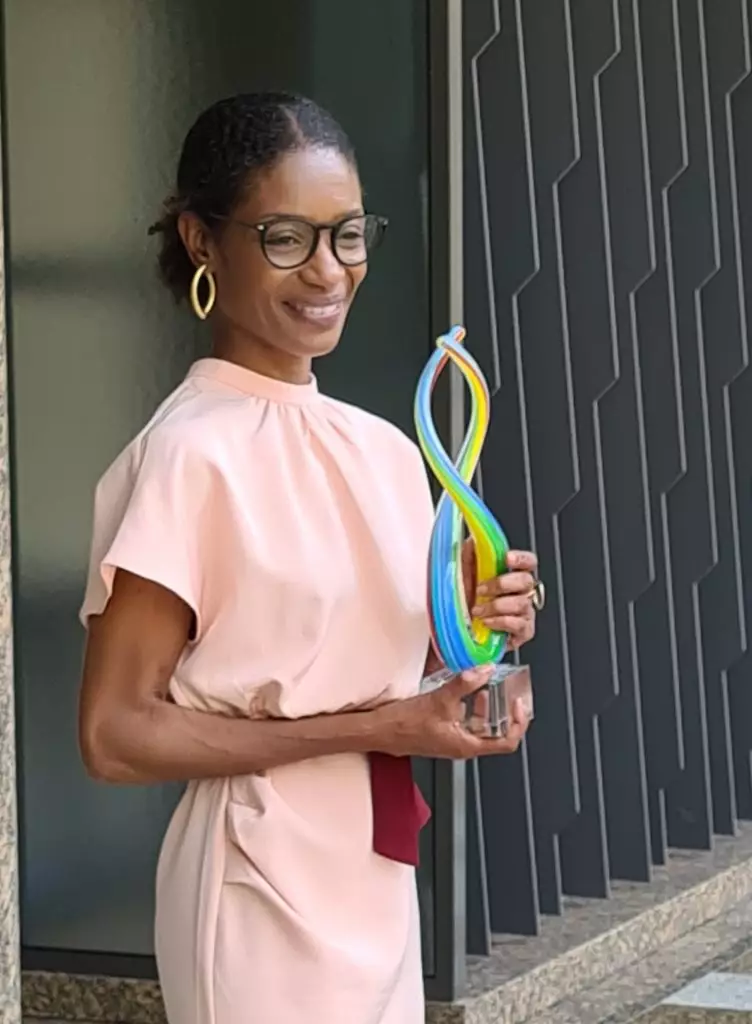
Sylvana Simons - Winner

Sylvana Simons of BIJ1 was named the Neuro-Inclusive Politician of 2021–2022.

The jury recognized her commitment to neurodiversity as a politician and party leader, her stance against harmful therapies such as ABA, her inclusive party ideology and her proactive embrace of neurodivergent candidates on the electoral list of the party she founded.

During her time as the NIP, she introduced the first neurodiversity-friendly motion, which all political parties in the Dutch House of Representatives unanimously supported.

Her win marked a moment of pride, recognition and political visibility for neurodivergent people in the Netherlands.

2019–2021

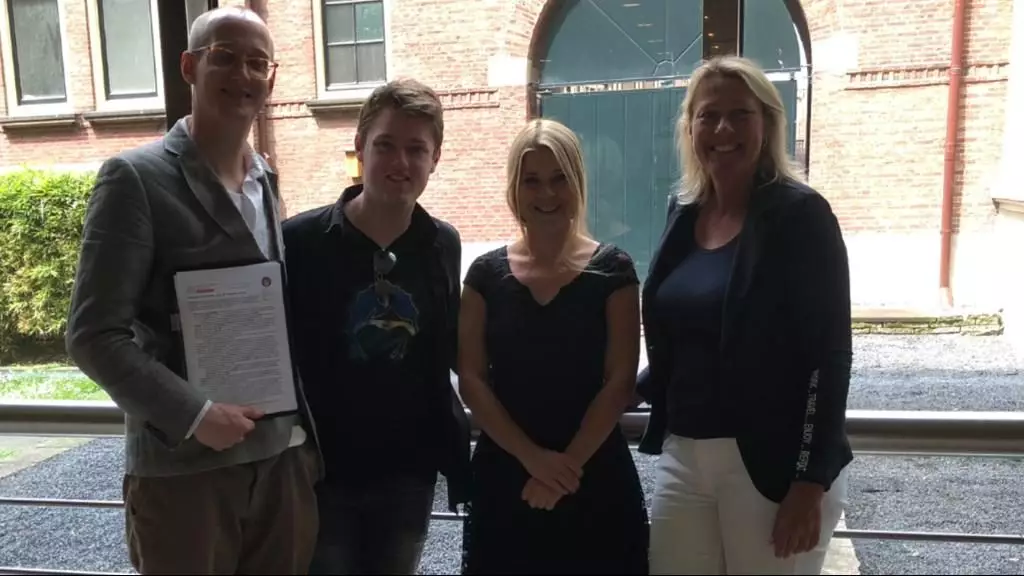
Lisa Westerveld - Winner  

Lisa Westerveld of GroenLinks was the first winner of the Neuro-Inclusive Politician Award.

The jury recognized that she repeatedly and courageously stood up for unheard young people, including neurodivergent young people.

She made history during her time as NIP by introducing the first motion in the Dutch House of Representatives in which neurodivergent people were named, in a neutral way, as a group in politics.

As a group, neurodivergent people were no longer invisible.

She was a politician who gave hope.

[IMAGE SUGGESTION: Lisa Westerveld / Tweede Kamer image - https://www.neurodiversiteit.nl/wp-content/uploads/2019/03/IMG-20180523-WA0002-1024x576.jpg]

Suggested link: Read the full story about Lisa Westerveld and the first NIP Award.
The 2023 nominees

The five nominees for the third edition of the NIP Award were selected after a research period. They emerged as political fighters for different actions and positions that supported the path toward a society that embraces every neurotype as a valuable contribution to the collective.

The 2023 nominees were:

  • Don Ceder, ChristenUnie - fighter for dyslexic citizens
  • Rene Peters, CDA - fighter for inclusive workplaces
  • Marijke van Beukering-Huijbregts, D66 - fighter for accommodation
  • Rudmer Heerema, VVD - fighter for gifted children
  • Peter Kwint, SP - political fighter for the underdogs

Rudmer Heerema and Peter Kwint were both nominated twice: for the 2021–2022 edition and the 2023–2024 edition.

How is the NIP Award winner chosen?

The NIP Award is based on a research and evaluation process.

Every two years, political parties are investigated for their added value to a neurodiverse society. Specific politicians are nominated when they show their influence in a constructive, inspiring or effective way in the political arena.

An independent jury of neurodivergent people evaluates the nominated candidates and their added value, commitment and action for a neuro-inclusive society.

The names of jury members are not made public before the award ceremony. This allows the jury to carry out its work without social media pressure, trolling or attempts at informal persuasion.

The winner is usually announced around Neurodiversity Pride Day. In 2025, because of the fall of the Dutch cabinet, the evaluation period was extended and the Dutch award ceremony took place later in the year.

International expansion

The NIP Award started in the Netherlands. In 2025, it was also awarded in India for the first time.

The idea is simple but powerful: in every country, there may be politicians worth recognizing for their efforts toward a neuro-inclusive society.

The Neurodiversity Foundation hopes that partners, friends and allies will be inspired to create their own NIP Awards in their own countries - rooted in their own political systems, languages and lived experiences, while connected by one shared principle:

Politicians who give neurodivergent people hope deserve to be seen.

Neurodiversity Scorecard for Political Parties

Rating political parties by topic

The participating political parties are studied from different angles and rated on selected topics by researchers.

In the 2023 edition, the parties were rated on seven selected topics by ten researchers. These topics were chosen for that edition, but of course they did not cover all issues relevant to neurodivergent people in the Netherlands.

Every two years, the scope of the research is updated.

Political parties that could be nominated for the third edition were D66, ChristenUnie, PvdA, SP, PvdD, VVD, CDA, SGP, DENK, FvD, PVV and Volt. GroenLinks and BIJ1 were also investigated, but did not participate in the 2023 edition because they had previous winners. Some of the smallest and newest political factions in the Dutch House of Representatives were not investigated.

[IMAGE SUGGESTION: Neurodiversity Scorecard 2022–2023 - https://www.neurodiversiteit.nl/wp-content/uploads/2023/02/Scorekaart-Neurodiversiteit-Neurodiversity-Foundation.png]

2025 scorecard note

The 2025 scorecard used a broader set of criteria than the 2023 scorecard. The 2023 scorecard had seven topics. The 2025 research used 25 criteria and served as a development step toward a more extensive evaluation method.

Because the 2025 research document did not reach publication quality, it should not be presented as an official published scorecard. It can be described as an internal research and development step that informed the jury process.

The ND Pride Education Campaign is a structured educational initiative designed to help students understand neurodiversity in a clear, accessible, and age-appropriate way.

Most schools still don’t teach what neurodiversity is, how different brains work, or why inclusion matters—leaving many students to navigate these topics socially, where misunderstanding can easily turn into stigma, bullying, or silence.

The campaign provides classroom-ready lesson materials and educational resources that support awareness, respect, and inclusive thinking. Designed for use in schools, classrooms, awareness weeks, special events, and teacher-led discussions, the program helps create a more informed and supportive environment for neurodivergent students.

The Anti-ABA Campaign is an advocacy and awareness initiative that critically examines Applied Behavior Analysis (ABA) and its impact on neurodivergent people, particularly autistic individuals. While ABA is often promoted as a standard, evidence-based, and necessary form of support, many autistic people and advocates have shared lived experiences that raise serious ethical concerns about its methods and long-term effects.

Harmful practices can persist when they become normalized, institutionalized, and rarely questioned in public discussions. This campaign centers the voices and experiences of neurodivergent individuals, challenges dominant narratives around behavioral intervention, and creates space for open, informed dialogue about ethics, consent, autonomy, and wellbeing. It is designed for use in advocacy work, education and training, policy discussions, and broader community conversations about neurodiversity and support practices.

The What’s STRONG With You? Campaign is an awareness and culture-change initiative built around a simple but powerful shift in perspective: moving from asking “What’s wrong with you?” to “What’s strong with you?” Too often, schools, workplaces, healthcare systems, and support services focus primarily on deficits—what needs fixing, what is not working, or what is missing—even when the intention is to help.

Over time, people can become defined by problems, gaps, and limitations, shaping both identity and expectations in damaging ways. This campaign encourages a strengths-based approach by reframing language, changing the questions we ask, and inviting people to see neurodivergent individuals through the lens of capability, potential, and contribution.

Through storytelling, public engagement, and practical resources, the campaign supports more positive and empowering conversations in schools, workplaces, coaching environments, public awareness initiatives, and community discussions.

The We’re Nuts Campaign is a bold public awareness campaign that challenges the way neurodivergent people are labeled, perceived, and dismissed by reclaiming language that has often been used against them.

Neurodivergent individuals are frequently subjected to dismissive language, pathologizing labels, and casual insults that shape not only perception, but also behavior, treatment, and social acceptance.

When harmful language goes unchallenged, it reinforces stigma, dehumanizes difference, and helps justify exclusion. This campaign confronts that dynamic directly by reclaiming charged language, flipping its meaning and perspective, and creating powerful moments of reflection, discomfort, and conversation.

Through public storytelling and unapologetic messaging, the campaign encourages people to question the words they use and the assumptions behind them. Designed for awareness campaigns, education and training, social media engagement, and public discourse, it is intended to spark conversations that are often avoided rather than soften them.

The Political Parties Assessment Framework is a structured evaluation tool designed to assess how political parties approach neurodiversity, inclusion, and related policy issues. Political commitments in these areas are often vague, difficult to verify, and hard to compare, making it challenging for voters, advocates, and stakeholders to understand where parties truly stand or what impact their policies may have in practice.

The framework provides clear evaluation criteria focused not only on public statements, but also on policy detail, implementation, accountability, and measurable action. By using comparative and evidence-based analysis, it helps separate rhetoric from genuine commitment and supports more informed public discussion around neurodiversity and inclusion in politics.

The framework is intended for use in policy analysis, advocacy work, public awareness initiatives, and efforts to strengthen political transparency and accountability.

Check-In Prompts for Children is a supportive card set designed to help children recognize, understand, and express their feelings, needs, experiences, and internal body signals—such as stress, hunger, overwhelm, or emotional states—in ways that feel accessible and safe.

Children are often expected to explain complex emotions clearly, self-regulate quickly, and communicate like adults, even when they may not yet have the language, confidence, or emotional awareness to do so. Without the right support, this can lead to frustration, misunderstandings, shutdowns, or distressed behavior.

The card set uses simple and flexible prompts that allow children to communicate verbally, visually, emotionally, or in whatever way works best for them, without pressure or “right” answers. Available in multiple languages and adaptable across different settings, the prompts are designed to encourage connection, understanding, and emotional awareness.

They can be used in home environments, classrooms, therapy and support settings, or as part of everyday check-ins and conversations.

The Interoceptive Awareness Cards are a reflective card set designed to help people recognize, understand, and respond to internal body signals such as hunger, stress, fatigue, tension, overwhelm, and emotional states.

Many people—particularly neurodivergent individuals—can struggle to notice these signals, interpret what they mean, or understand how to respond to them in supportive ways.

Without this awareness, needs may go unrecognized until they become intense, leading to overwhelm, shutdown, burnout, or difficulty with self-regulation. The cards provide gentle prompts and accessible language to help identify internal sensations, build self-awareness, and develop a clearer understanding of physical and emotional states over time.

Designed for flexible and self-paced use, they can support personal reflection, therapy and coaching sessions, educational environments, and everyday regulation and awareness practices.

The Strengths-Based IEP Tool is a practical resource designed to support the development of Individual Education Plans (IEPs) that focus on a student’s strengths, context, and genuine support needs rather than only deficits or areas requiring correction.

Traditional IEP processes often center on gaps, challenges, and behaviors to “fix,” which can shape how students are perceived and treated within educational systems. As a result, many students are reduced to problems to manage, behaviors to correct, or targets to improve, rather than being understood as whole individuals with abilities, interests, and potential.

This tool encourages a strengths-first approach by helping educators and support teams build more balanced, respectful, and effective plans through structured prompts and contextual understanding.

Flexible enough to work across different educational systems and settings, it is designed for IEP development, educator training, inclusive education strategies, and collaborative conversations between schools and families.

The Neuroinclusive Listening Cards are a practical tool designed to help people develop listening skills that better respect and understand neurodivergent communication styles.

Traditional ideas about listening often focus on waiting for a turn to speak, interpreting quickly, or responding efficiently, but this can overlook what meaningful understanding actually requires. Conversations frequently break down when people feel misunderstood, communication signals are misread, or assumptions are used to fill in gaps instead of genuine curiosity and attention.

The cards use guided prompts, reflective scenarios, and practical exercises to encourage slower, more intentional listening that prioritizes understanding over immediate response. By challenging default assumptions and helping people pay closer attention to different communication styles, the tool supports more respectful, effective, and inclusive interactions.

It is designed for use in training sessions, workshops, team communication exercises, facilitation settings, and personal development contexts.

The Thriving at Work guide is a practical resource for building genuinely neuroinclusive workplaces by focusing on team design, communication systems, leadership practices, and organizational structures rather than placing the burden solely on individual adjustment. Many workplace neurodiversity initiatives focus heavily on accommodations or celebrating “neurodivergent talent” while leaving the underlying systems, expectations, and working environments unchanged. As a result, neurodivergent employees often continue to experience overload, unclear communication, constant friction, and preventable stress, while these challenges are frequently misread as personal performance or attitude issues rather than signs of systemic mismatch. This guide takes a broader and more sustainable approach by rethinking workplace norms, offering practical adjustments to communication and workflow structures, emphasizing leadership responsibility, and supporting healthier team design that works for a wider range of people. Rather than treating inclusion as an individual exception process, it encourages organizations to build environments where different working styles can genuinely thrive. The guide is designed for team discussions, HR and policy development, leadership alignment, organizational redesign, and wider workplace inclusion initiatives.

The What’s ALIVE in You? publication is a reflective exploration of camouflaging, burnout, survival, and the process of reconnecting with what feels real, meaningful, and alive underneath years of adaptation. Masking is often treated as a skill, a necessity, or even a success strategy, particularly for neurodivergent people navigating environments that reward conformity. What is far less acknowledged is the long-term cost of constantly performing, suppressing needs, or disconnecting from oneself in order to cope.

Many people eventually reach a point where the strategies that once helped them survive stop working. Functioning becomes unsustainable, exhaustion deepens, and life can begin to feel emotionally flat, disconnected, or unreal—yet the response they often receive is to try harder, stay productive, or keep pushing through. This publication creates space to explore those experiences without judgment or forced positivity.

Through reflections on masking and survival, language for disconnection and depletion, and gentle prompts that help people notice what still feels present underneath the exhaustion, the publication supports honest self-exploration at a self-directed pace. Designed for individual reflection, burnout recovery, coaching or group settings, and identity-focused work, it makes space for uncertainty, ambivalence, and the complexity of rebuilding connection with oneself.

The What’s STRONG With You? (Journal for Teens) is a guided reflection journal designed to support neurodivergent teenagers as they navigate identity, pressure, self-understanding, and the challenges of growing up in systems that constantly evaluate them. Teens are surrounded by expectations from schools, peers, social media, and adults, and are often expected to explain who they are before they have had the chance to fully understand themselves. As a result, many end up masking heavily, internalizing blame, disconnecting from their own needs, or feeling pressured to fit into definitions that do not reflect their real experiences.

Most self-development tools expect a level of clarity, confidence, or emotional insight that many teenagers are still developing. This journal takes a different approach by offering short, accessible prompts that encourage exploration without pressure or judgment. It creates space for writing, drawing, non-linear thinking, and personal reflection while focusing on energy, interests, boundaries, and self-awareness rather than performance or “fixing” behavior.

Designed to be flexible and self-paced, the journal has no required order, no expectation of completion, and no “correct” way to use it. It is intended for private reflection, optional supported use with trusted adults, coaching or educational settings, and as a companion to meaningful conversations rather than a replacement for them.

The What’s STRONG With You? Toolkit is a practical resource built around a simple but powerful shift in perspective: moving from asking “What’s wrong with you?” to “What’s strong with you?” Many systems—including education, workplaces, healthcare, and support environments—default to deficit-based thinking by focusing primarily on what needs fixing, what is not working, or what is missing, even when the intention is to be supportive. Over time, this shapes how people see themselves and how others see them.

The toolkit is designed to help challenge that mindset by reframing questions, language, and conversations around strengths, capability, potential, and human variation. Through practical tools, storytelling, reflective prompts, and engagement activities, it encourages people to look beyond deficits and build more balanced, respectful, and empowering ways of understanding neurodivergence and identity.

Designed for flexible use across different environments, the toolkit can support schools and educational settings, workplace culture initiatives, public awareness campaigns, coaching, facilitation, and community conversations. Rather than offering a one-size-fits-all model, it provides adaptable resources that help create more strengths-based and inclusive interactions in everyday life.

The NeuroEmergence Program is designed for people navigating the identity shifts that can happen after discovering, recognizing, or being diagnosed as neurodivergent. Recognition is often described as a moment of clarity or relief, but for many people it also brings grief, anger, confusion, exhaustion, or a deep re-evaluation of past experiences. After that initial realization, many are left without meaningful support for what comes next.

The program focuses not just on understanding neurodivergence, but on rebuilding a relationship with oneself after years of masking, misunderstanding, survival strategies, or unmet needs. It creates space for reinterpreting past experiences, understanding the emotional and physical costs of masking, redefining boundaries and identity, and making sense of the complexity that can emerge during this process. Rather than pushing people toward a fixed outcome, the program recognizes that identity shifts are deeply personal, non-linear, and often emotionally layered.

Designed to support people at different stages of self-recognition and change, the NeuroEmergence Program can be used during post-diagnosis adjustment, burnout recovery phases, identity transitions, and facilitated group environments. It offers space for reflection, exploration, and rebuilding without pressure, forced timelines, or expectations about who someone should become.

The EFURM Program is a program focused on energy, regulation, and long-term sustainability for neurodivergent people. It is not about productivity hacks, constant self-optimization, or pushing people to perform beyond their limits. Instead, the program centers on building ways of living and working that are actually sustainable over time, both emotionally and physically.

Many systems teach people to push through exhaustion, ignore discomfort, disconnect from their needs, and treat burnout as a personal failure rather than a warning sign. For neurodivergent people especially, this often creates repeated cycles of overextension, collapse, recovery, and burnout again. The program challenges those patterns by helping people better understand energy variability, recognize overload and shutdown patterns, separate self-worth from output, and redesign expectations in more realistic and supportive ways.

Through reflection, practical frameworks, and sustainable approaches to regulation and recovery, the EFURM Program supports people in rebuilding rhythms that work with their nervous system rather than against it. It is designed for personal development, coaching and facilitation settings, workplace wellbeing initiatives, and long-term recovery and sustainability journeys.

The Facilitator / Trainer Course is designed for trainers, educators, facilitators, and professionals who want to teach neurodiversity in a responsible, ethical, and meaningful way. The course is built on a simple principle: how neurodiversity is taught matters just as much as what is being taught. Even well-intentioned training can cause harm when complex lived experiences are oversimplified, reduced to slogans, or delivered without awareness of power, consent, and context.

Many neurodiversity training environments unintentionally create problems such as forced disclosure, tokenizing lived experience, extracting emotional labor from neurodivergent people, or presenting overly simplistic narratives that erase complexity. This course addresses those risks directly by exploring the ethics of facilitation, power dynamics in learning spaces, consent-based teaching practices, and ways to navigate discomfort, disagreement, and emotionally charged discussions with care and professionalism.

The course also focuses on translating neurodiversity theory into practical, real-world application across different environments and audiences. It is designed to help organizations train internal facilitators, improve the quality and integrity of neurodiversity education, professionalize facilitation practices, and prepare people to confidently deliver NEA content in ways that are respectful, informed, and sustainable.

The Educator / School Track is a course designed for teachers, school staff, and education professionals who want to embed neurodiversity into everyday teaching practice rather than treating inclusion as a separate initiative or occasional accommodation. The course focuses on turning inclusion from intention into practical, sustainable action within real classrooms and school systems.

Teachers are often told to “be inclusive” without being given the time, tools, flexibility, or structural support needed to make that possible. As a result, many educators are left trying to improvise within rigid systems that were not designed with neurodivergent students in mind. This course addresses that gap by providing practical, reality-based approaches that help educators better understand how learning, communication, sensory experiences, and regulation can differ across students.

The course explores neurodiversity-informed learning models, classroom and sensory design, rethinking expectations and assessment methods, and improving communication with students and families. Rather than offering abstract theory alone, it focuses on practical shifts that can be applied within existing educational environments. It is designed for teacher training and professional development, whole-school inclusion strategies, classroom-level improvements, and wider education reform initiatives.

The Leadership & Neuro-Inclusion course is an advanced program designed for leaders, executives, boards, and decision-makers who want to understand how power, systems, and organizational norms shape inclusion in practice. This course is not centered on empathy alone—it focuses on responsibility, accountability, and the reality that inclusion is ultimately shaped by leadership decisions, priorities, and structures.

Many inclusion efforts fail because responsibility is delegated downward while the systems, assumptions, and power structures that create exclusion remain untouched. Organizations often invest in awareness campaigns or individual accommodations while leadership practices, decision-making processes, and institutional norms continue to reinforce the same barriers. This course challenges leaders to examine the systems they shape and the unintended consequences of the environments they create.

Through exploration of power dynamics, hidden leadership assumptions, structural versus interpersonal inclusion, and real-world case reflections, the course encourages leaders to move beyond performative inclusion toward meaningful organizational change. It is designed for leadership teams, boards, organizational transformation initiatives, stalled inclusion efforts, and periods of growth or structural change where long-term cultural direction is being shaped.

The Neurodiversity Fundamentals course is a foundational program designed to explain neurodiversity as a practical, ethical, and systemic framework rather than simply a collection of diagnoses or labels. It gives individuals, teams, and organizations a clearer way to understand neurodiversity in real-world contexts, beyond trends, assumptions, or oversimplified awareness messaging.

Many people encounter neurodiversity through fragmented online content, medical models without social or environmental context, or workplace initiatives that prioritize buzzwords over understanding. The result is often confusion, resistance, shallow adoption, or conversations that quickly become disconnected from lived reality. This course creates a stronger shared foundation by introducing a common language and framework that can support more informed, grounded, and sustainable discussions about neurodiversity and inclusion.

The course explores core concepts of neurodiversity and human variation, the relationship between traits, identity, and environment, common myths and misconceptions, and the real-world implications for workplaces, education systems, and policy development. Combining theory with practical reflection, it is designed to be used as a starting point for teams and organizations, before implementing inclusion initiatives, to align groups with different levels of understanding, or as a reset point when conversations around neurodiversity have become confused, reactive, or unproductive.

The Brainy App is an educational app designed to help children, families, and educators understand neurodiversity in simple, relatable, and accessible ways. Rather than relying on clinical language or oversimplified slogans, the app helps turn complex ideas about brain differences into conversations that children and adults can actually engage with and understand together.

Neurodiversity is often explained either through medical jargon that feels distant and confusing, or through overly simplified messaging that loses nuance and meaning. Neither approach works particularly well for children who are still developing their understanding of themselves and others. The Brainy App bridges that gap by using strengths-aware explanations, visual metaphors, interactive content, and guided conversation prompts that make abstract concepts easier to explore in everyday life.

Designed to build shared understanding rather than assign labels, the app encourages curiosity, empathy, and open discussion around different ways of thinking, learning, feeling, and communicating. It can be used to start conversations with children, support classroom discussions, help families develop shared language, and explore brain differences without requiring diagnosis-focused frameworks.

The Stride App is a personal support tool designed to help people navigate daily life with more structure, awareness, and flexibility—without turning self-support into a productivity contest. Rather than focusing on constant optimization or performance, the app is built around the idea of creating gentle structure without pressure, helping people stay oriented in ways that feel sustainable and adaptable.

Many support and productivity tools rely heavily on tracking systems, streaks, accountability pressure, scoring, and optimization models. While those approaches can work for some people temporarily, they often become overwhelming, guilt-inducing, or unsustainable over time—especially for neurodivergent users navigating fluctuating energy, executive functioning challenges, or burnout. Stride takes a different approach by using gentle prompts instead of deadlines, reflection instead of scoring, and flexible structures that users can adapt, pause, ignore, or return to as needed.

The app is designed to meet people where they are on any given day, without moralizing productivity or attaching worth to consistency. It can help users notice patterns in energy and focus, create light structure without rigidity, maintain orientation during difficult periods, and support everyday functioning in a more compassionate and realistic way. Designed for flexible use, Stride encourages people to dip in and out based on need rather than pressure or obligation.

The NEA Community App is a dedicated community space designed to support people before, during, and after participating in NEA courses and programs. It focuses on the in-between moments where real learning, reflection, and integration often happen—after the workshop ends, once the initial emotions settle, or when questions only begin to surface later in everyday life.

Too often, learning experiences lose momentum as soon as a course finishes, a workshop ends, or a discussion channel becomes inactive. People lose connection, context, and the opportunity to continue processing ideas in ways that feel meaningful and applicable to real situations. The NEA Community App is designed to extend learning beyond the formal session by creating quieter, more sustainable spaces for ongoing reflection and connection.

The app includes course-linked discussion spaces, ongoing facilitator presence, shared resources, reflective conversations, and asynchronous participation that allows people to engage at their own pace without pressure to constantly contribute or perform. Rather than creating noise or demanding engagement, it provides space for people to think, revisit ideas, ask questions when they genuinely arise, stay connected across cohorts, and share experiences without needing everything to be polished, immediate, or fully figured out.

The Friends Fire ecosystem is a digital space for connection, friendship, and dating designed specifically with neurodivergent people in mind. More than just another social platform, it rethinks the social rules that most online spaces are built around. Traditional platforms often depend on fast responses, unspoken social expectations, performative profiles, ambiguous communication, and engagement-driven design that can feel exhausting, confusing, or unsafe for many neurodivergent users.

In many online environments, people end up masking heavily, second-guessing social signals, navigating unclear boundaries, or experiencing social burnout from the constant pressure to perform and stay visible. Friends Fire takes a different approach by shifting the focus from performance to clarity. Instead of rewarding speed, popularity, or endless engagement, the platform is designed around more intentional, transparent, and respectful interaction.

The ecosystem supports slower-paced communication, clearer signals and expectations, consent-aware design, and social interaction without manipulative or gamified engagement loops. Its goal is not to maximize attention or screen time, but to create an environment where people can feel safer, more understood, and more able to connect without constantly navigating hidden rules or social pressure.

The NIP Award Assessment Framework is a structured evaluation framework designed to assess political leaders on neuroinclusion based on measurable actions, policies, and long-term impact rather than visibility, public statements, or performative support. Political recognition is often shaped by optics, media presence, or good intentions, while the actual outcomes of policies and leadership decisions remain difficult to evaluate clearly or consistently.

Neuroinclusion in politics is frequently vague, poorly defined, and easy to present superficially without meaningful structural change. This framework addresses that gap by introducing clearer standards, evidence-based assessment, and greater accountability into how political leadership on neuroinclusion is evaluated. Rather than rewarding charisma or public relations messaging, it focuses on consistency, implementation, context, and demonstrable impact.

The framework evaluates policy decisions, leadership practices, and long-term commitments using real evidence rather than promotional narratives. It also accounts for political context and is designed to reduce bias linked to media visibility, personality, or public image. The NIP Award Assessment Framework can be used to assess nominees, support independent juries and review panels, and provide transparent reasoning behind recognition, evaluation, and decision-making processes.

The Autvinder Evaluation Framework is a structured assessment tool designed to evaluate ideas and innovations fairly, without rewarding performance, confidence, or presentation style over substance. Created specifically with neurodivergent creators in mind, it challenges the way many competitions and innovation spaces prioritize social fluency, quick pitching, charisma, and polish instead of the actual value or potential of an idea.

Many strong ideas are overlooked because they are presented differently, do not fit expected formats, or are delivered without the confidence, speed, or social ease that traditional judging processes tend to reward. This framework separates the quality of the idea from the delivery style, helping juries focus on what matters: impact, originality, feasibility, relevance, and potential.

The framework provides clear evaluation criteria, bias-aware jury guidance, contextual interpretation, and a slower, more deliberate assessment process. By reducing reliance on charisma, speed, or performance, it creates a fairer way to recognize meaningful innovation and support neurodivergent creators whose ideas may otherwise be underestimated or misunderstood.

The Narrative Arc Framework is a communication framework designed to help people explain complex, sensitive, or challenging topics without losing clarity, creating unnecessary resistance, or compromising dignity. Rather than focusing only on what is being communicated, the framework focuses on the order and structure in which ideas are introduced, recognizing that sequence strongly shapes how people receive and respond to information.

When communication skips important stages, conversations often break down into defensiveness, confusion, misunderstanding, or disengagement. People may feel overwhelmed, judged, or disconnected before shared understanding has even been established. The Narrative Arc Framework addresses this by creating a more intentional pathway through difficult conversations and complex ideas.

The framework is built around five stages: Story, which creates a human entry point; Philosophy, which introduces the underlying worldview; Meaning, which builds shared understanding; Invitation, which encourages voluntary engagement rather than pressure; and Dignity, which reinforces unconditional human worth throughout the process. Missing one of these stages can weaken communication and reduce trust or engagement. The framework is designed for keynotes, campaigns, policy communication, training, facilitation, and situations involving mixed, resistant, or skeptical audiences where careful communication structure matters most.

The Neurodignity Framework is the ethical foundation that underpins the entire ecosystem. It defines the principles, boundaries, and standards for what meaningful inclusion, support, and participation should actually look like in practice. Rather than treating dignity as something conditional, aspirational, or secondary to performance, the framework establishes it as a non-negotiable starting point.

Many initiatives described as “inclusive” can still cause harm when they prioritize productivity over wellbeing, treat accessibility as optional, or expect neurodivergent people to constantly prove their value, adaptability, or worthiness of support. Neurodivergent individuals are often expected to endlessly adapt to systems that were never designed with them in mind, perform gratitude for basic inclusion, or earn dignity through output and compliance. The Neurodignity Framework rejects those assumptions entirely.

The framework is used to guide the design of tools, programs, policies, partnerships, governance decisions, and internal organizational choices across the ecosystem. It also acts as a reference point for evaluating whether initiatives genuinely align with neuroinclusive values in practice rather than only in language. Without a framework like this, inclusion can easily become performative or inconsistent. With it, dignity remains central, protected, and embedded into decision-making at every level.

The Neuro-Inclusive City Scorecard is a structured framework designed to help cities evaluate how inclusive they truly are for neurodivergent people across entire systems, not just through isolated policies or symbolic initiatives. Inclusion is often treated as a checklist item, compliance requirement, or niche social issue, but this framework reframes it as a broader question of system design, public infrastructure, and civic responsibility.

Rather than relying on simple pass/fail measures, the scorecard uses a multi-domain assessment approach that examines areas such as education, public spaces, governance, communication, accessibility, participation, and community life. It combines qualitative and quantitative inputs to identify patterns, strengths, blind spots, and systemic barriers across departments and institutions. The framework is designed with developmental logic in mind, helping cities understand not only where they currently stand, but also where improvement efforts should be focused next.

Used collaboratively with stakeholders, the scorecard can help establish a baseline for city-wide neuroinclusion, identify gaps between policy and lived experience, prioritize interventions, and track progress over time. More importantly, it shifts inclusion away from charity-based thinking and toward structural accountability by asking a more fundamental question: who is this city actually built for?

Neuroprofiler is a reflective tool designed to help individuals and teams better understand how neurodivergent patterns show up in everyday life, without reducing people to diagnoses, labels, fixed identities, or simplistic personality categories. Many neurodivergent experiences are routinely misunderstood or misinterpreted: exhaustion is seen as a lack of motivation, overwhelm is mistaken for resistance, and difference is treated as deficit rather than context-dependent variation.

Traditional diagnostic pathways are often slow, inaccessible, expensive, or heavily medicalized, while many personality tools flatten complexity and ignore the real-world needs, environments, and pressures that shape how people function. Neuroprofiler was created to sit between these extremes by offering a more human, contextual, and practical way to reflect on patterns of thinking, energy, communication, regulation, and interaction.

Rather than producing rigid labels or definitive categories, Neuroprofiler generates pattern-based insights that describe tendencies, friction points, and support needs in ways that encourage understanding and conversation. It can be used to prepare for workplace adjustments, improve team collaboration, support educator–student understanding, and help individuals reflect on their own patterns and needs more clearly. It is not a diagnosis, a hiring tool, a performance predictor, or a personality test. Instead of asking “What is wrong with this person?”, Neuroprofiler shifts the focus toward a different question: where is the mismatch between the person and the system around them?